

 LinkedIn
I spent nine years mining search term reports at 1am while clients slept. Prompts are the new search terms, and most businesses grade their AI visibility the way bad agencies graded PPC: one screenshot, no baseline, no control.
How can my business measure brand visibility across ChatGPT, Gemini and Google AI Overviews?
I will push back a little, because the question hides three different jobs. TechRadar puts it cleanly: are you named in the answer, does anyone click through to you, and can the bots fetch your pages at all? Its AI visibility tracking rundown separates those signals. I have seen a mention rate climb while AI referral traffic sat flat. Those are separate funnels. Mixing them is how you lie to yourself.
The PPC version I trust is boring on purpose:
- Pick 30 to 50 real buyer prompts, including problems, categories and comparisons. Keep the list stable long enough to establish a baseline.
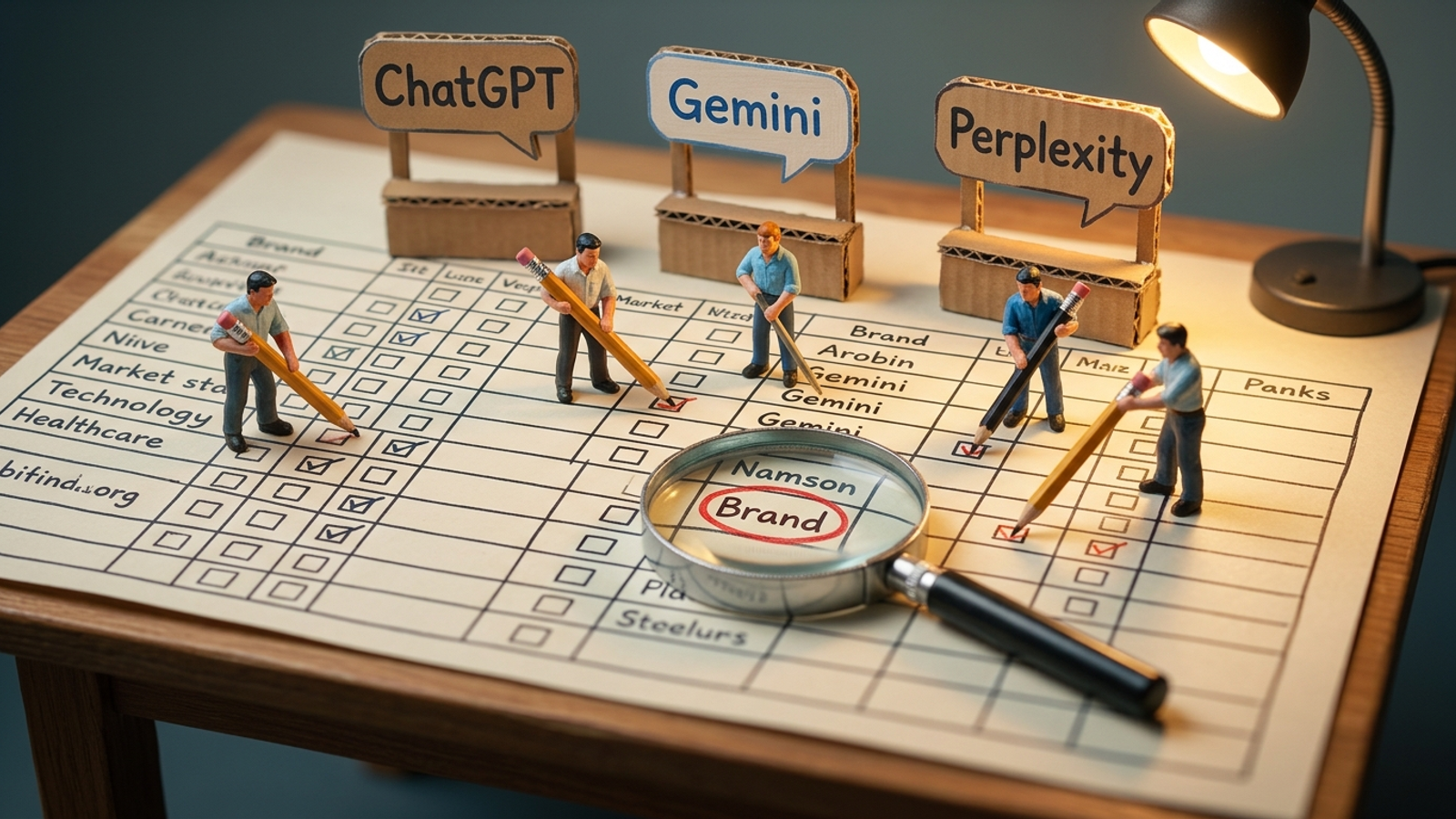
- Run them on a fixed schedule in clean sessions with no memory. Record which answer mentions you, which cites you, and which recommends you.
- Score brand visibility as (answers mentioning your brand / total answers) × 100. That is a mention rate, not a stand-in for traffic or sales. Here is how the Brand Visibility Score is calculated.
- Put two named competitors beside your results. Watch the four-week trend rather than announcing victory over one answer.
One screenshot proves nothing because answers wobble from run to run. SparkToro ran 2,961 runs across ChatGPT and Google AI and got the same brand list in the same order about 1 in 1,000 times, a useful warning against one-time visibility checks. I run money prompts twice for that reason. The point is not to make every answer identical; it is to see whether a pattern survives the wobble.
If you want a routine to copy before buying a tool, run The 30-Prompt Test for AI Search Visibility. Build the baseline first. Otherwise, you have no way to tell whether the tool found a change or merely gave a screenshot a monthly subscription.
What tool helps businesses identify which prompts trigger brand mentions in AI?
None of them find the prompts for you, and that is where buyers get burned. Every AEO tool I have tried works the same way underneath: you supply a fixed prompt set, it runs those prompts, captures the answers, then counts mentions, citations, sentiment and share of voice. HubSpot’s AEO tool rundown describes the machinery. The tool is a counter. The prompt list is the strategy, same as keywords were.
Feed it ten brand-name prompts and you may get a pretty 90% visibility score that means nothing. Brand-name prompts almost always hit. I would rather know whether someone asking for the kind of service you sell hears your name before they know to type it. That is the part a brand-name score cannot tell you.
I build the list the way I used to mine search terms. Pull phrasing from sales calls, support tickets and converting queries in Search Console. Then sort it into:
- Problem prompts: the buyer describes what is wrong without naming a solution.
- Category prompts: the buyer knows the type of product or service they need.
- Comparison prompts: the buyer is weighing options.
- Brand prompts: a small control group, not the main event.
I score mention (named), citation (linked as a source) and recommendation (told to buy or hire) separately. They move independently, and I weight category and problem prompts heaviest. The distinction is laid out in this mention, citation and recommendation scoring approach. If mentions rise while recommendations do not, I do not call that a win and move on. I look at the answers.
On price, the July 2026 band runs from Otterly at $29 a month for 15 prompts, past Semrush at $99 a month per domain, to Profound at $399 to $499-plus. For a small team, I would buy only once the manual habit exists and the hours cost more than the subscription. Those are the July 2026 paid price bands; they are not a reason to outsource choosing your prompts.
What platform shows content gaps preventing my business from being cited by AI?
No platform shows you a gap directly. The useful ones show you cited domains and pages per prompt. You infer the gap when a competitor owns ten prompts where you never appear. That is the view I would look for in a visibility tool, not another overall score that hides which answers you lost.
I learned to separate rankings from citations through the ranking-citation gap Go Fish Digital describes: a page can sit in positions 1 to 3 and still get zero AI citations. Models may select for clarity, freshness and corroborated facts, often preferring third-party lists and reviews. That is why a ranking page can miss AI citations. Rewriting it to rank higher will not necessarily fix that. Rewriting it to be quotable might.
I split what I see into three gaps because each points to a different job:
- A mention gap means the model does not know you as an entity. The fix is presence on places such as Wikipedia, Crunchbase and G2.
- A citation gap means you have no extractable original numbers for it to quote. The fix is a page with the direct answer first, short paragraphs, a claim with a source and a number, and a table.
- A recommendation gap means reviewers and comparison pages do not name you against objective criteria. More copy on your own site does not fill that gap by itself.
That split comes from practitioner work on citation filters. I use it because it stops me from fixing the wrong problem. If you are named but never cited, adding another profile is not the first thing I would do. If you are cited but never recommended, polishing the same quotation again misses the question the buyer asked.
The Ahrefs March 2026 study of 863,000 SERPs backs the urgency: only 37.9 to 38% of cited pages ranked in the top 10 for the same keyword, while branded web mentions correlated at 0.664 with AI Overview visibility against 0.218 for backlinks. Those figures appear in this ranking-citation discussion. Find the missing stage before choosing the fix. A rankings report alone will not do it.
How do I get my business cited as a source in ChatGPT and Perplexity answers?
I used to tell clients citations were a content problem. I was wrong. The four citation filters give me a better order: eligibility, retrieval, extractability, attribution. Miss one and a beautifully edited page can still sit out the answer.
- Eligibility: Your page returns a 200 status, no paywall blocks the answer, and you allow GPTBot, ClaudeBot, PerplexityBot, Google-Extended and Applebot-Extended. I still find sites that rank in Google but block those bots. Go Fish Digital describes how blocked bots and heavy client-side JavaScript can leave AI retrievers with nothing useful to fetch, even when Google ranks the page. Check that problem before rewriting a word.
- Retrieval: Buyer wording decides whether the page enters the candidate set. Systems expand one question into 5 to 15 fan-out queries. In a Perplexity teardown of eight captures, retrieved and cited sources were different lists: YouTube was cited heavily while Reddit was retrieved and then ignored. Being found is not the finish line.
- Extractability: Give the retriever something it can lift without untangling an essay. Put a direct answer first, use headings that match the question, keep paragraphs under four sentences, and support a claim with a source and a number. A small table can do more work than another long introduction.
- Attribution: Check whether the final answer actually credits the page. A retrieved page that never becomes a citation is not a citation win, however pleasing the retrieval report looks.
The default fan-out stays close to literal phrasing, so I favor the words buyers type over a clever heading that means the same thing only after someone explains it. That does not mean repeating a phrase until the page reads like a 2015 landing page. It means answering the question plainly in a standalone chunk.
Access first, wording second, chunk third. Skip that order and you can spend a week polishing a page the engines never fetch. Then run the same prompt set again and check citations, not just whether the page still ranks.
How can a small business automate brand monitoring in AI search in-house?
Start free the way TechRadar describes it: run 10 to 30 real buyer prompts on a fixed schedule across ChatGPT, Gemini, Perplexity and Claude. Log the answers in a sheet using clean sessions with no memory. Its free sheet routine is enough to establish the habit. A smaller list you actually run beats a grand prompt library you open once.
Leave the prompts stable and watch the monthly trend, not one result. Add Google Search Console’s generative-AI report from June 3, 2026 as another baseline. It shows impressions by page, country and device for AI Overviews, AI Mode and Discover, but no clicks or queries yet. Here is what that report covers. It tells you where Google surfaced you. Your sheet tells you what the answers said to buyers. Keep both views; do not pretend they measure the same thing.
When the manual habit sticks, automate the counting. The DIY tracking pattern is simple:
- Store 10 to 20 prompts and the competitor names you want to watch.
- Call the Perplexity Sonar API for each prompt.
- Parse the answers for your brand, domain and competitors.
- Write timestamped rows, then run the job monthly on a cron schedule.
Base Sonar runs about $1 per million tokens plus $5 to $12 per 1,000 search requests. A typical brand check costs about a penny, and a 20-prompt audit lands under $1. n8n templates can read prompts from Google Sheets and write back results in the low single digits per month for 25 prompts weekly; those are the DIY cost estimates. I cost the in-house version at two hours to build and 30 minutes a week to read. If you want the build steps, copy Build Your Own AI Mention Tracker With a Spreadsheet.
That last half-hour matters more than the cheap API call. Look at the answers where your score changed. Was the brand merely named, linked as a source, or recommended? Did a competitor move too? Automate the counting, never the prompt list or the judgment.
Who should skip it and hand it off
Skip the DIY version if you already know you will not run it. I mean the shop with 60 buyer prompts across three services, the team where nobody owns the sheet, the owner who tried a tracker for two weeks and then let it rot. I have been that owner. The failure mode is always the same: prompts go stale, sessions stay logged in so memory skews results, and nobody re-runs the control prompts after a site change. At that point, the cheap audit costs you the decisions you missed. That is where I hand the counting to groas. It tracks prompts, AI answers, citations and share of voice continuously instead of when someone remembers, with every action logged alongside its reasoning. No dashboards to interpret. No junior manager learning on your budget.
The one metric I’d watch weekly
If you keep one number, keep recommendation share on 20 money prompts versus two named competitors. Not mentions. Not Search Console impressions, which Google confirms are impressions only, with no clicks or query breakdown. Recommendations are the answers where the model tells a buyer who to hire. I run the same 20 prompts twice a week in clean sessions, score who gets recommended and log what changed after each fix.
A weekly number gives you a reason to look. Four weeks tell you whether the movement stuck. If mentions rise but recommendations do not, I want to see that in the sheet, not hidden inside a cheerful average. Everything else is commentary.
The question I wish you’d ask: what changed after the fix?
Nobody asks this one, and it is the only one that pays. Everyone wants the score. I want the log next to it: date, prompt-set version, what I changed, recommendation share before, two weeks after and four weeks after. Without the change log, you cannot tell progress from a good-looking Tuesday.
That is how I used to read a search term report. I did not celebrate a lower CPA on Tuesday. I celebrated when the lower CPA was still there in week three and I could point to the three negatives and two bid changes behind it. The same discipline belongs here: keep the prompts steady, keep the two competitors in view, and write down what you changed before you inspect the next answer.
Say you are spending $20k a month and your recommendation share on 20 money prompts moves from 15% to 35% after you ship a quotable pricing page and fix bot blocking. That is a result worth investigating and trying to sustain. A screenshot of one answer naming you is vanity. I keep the log in the same sheet as the prompts, one row per change, because memory lies and sheets do not. When groas runs this for a client, that log is the weekly report: where you are named, what moved and why. When you run it yourself, it stops you from undoing a fix that was working.
Prompts are the new search terms. Count them like search terms, or stop counting. Pick the money prompts, run them clean and twice, score mentions, citations and recommendations separately, and judge every fix by whether the recommendation line moves for four weeks against the same two competitors. Do that and you will know more about your AI visibility than most agencies selling it. Skip it and you will have what I had in 2017: a thick report, a thin result, and a client asking why the graph went up while the phone stayed quiet.