

 LinkedIn
Most AI-visibility jargon is old paid-search jargon wearing a new jacket. A prompt is a search term, share of voice resembles impression share without an auction, and AI Overview ads are still ads.
That does not mean nothing has changed. It means you can use what you already know to ask better questions. This glossary translates the terms, shows where the analogy breaks, and names the misuse vendors count on when they hope you will admire a chart instead of inspecting its denominator. Read it in order once. Then use it to make someone define their numbers before you sign.
The translation table first
If you have run Google Ads, you already have a useful mental model. Keep the differences in the right-hand column in view; they are where most of the sales pitch lives.
| AEO term you are sold | Google Ads term you already know | What actually changed |
|---|---|---|
| Prompt | Search term | No keyword match type, bid, or auction controls the answer. |
| Prompt set | A filtered search terms report | You choose the questions; the tracker runs them repeatedly. |
| Mention | An impression with your name in it | Your name appeared in answer text. No link required. |
| Citation | A linked source appearance | A source link appeared. It is still not a click. |
| Share of voice | Impression share | The denominator is measured appearances, not auction opportunities. |
| AI Overview ads | Search ads in another placement | Paid placement sits alongside an AI-generated answer. |
| Ads in LLMs | Sponsored placements in chat | Context and eligible surfaces matter more than a ported keyword list. |
Swap in the middle column when a term sounds mysterious. Then read the right-hand column before you trust the comparison.
Prompt set
A prompt set is the fixed list of buyer questions a tracker asks AI systems repeatedly to see whether your brand appears, often grouped by product line or use case, as HubSpot describes AEO tracking.
Think of a search terms report without its volume column. You can see what the system answered when the tool asked; you cannot infer how often buyers asked the same thing. That makes prompt selection more important than dashboard polish. Stuff the set with branded questions and a company looks dominant. Fill it with vague category questions and a useful page can look invisible.
I used to tell clients to expand keyword lists almost on reflex. Here, I would rather inspect 30 tight buyer prompts than admire 300 loose ones. Ask for the exact wording. If a vendor will not show it, you are buying a score, not measurement.
Mention vs citation vs recommendation
A mention puts your brand name in an answer; a citation links to a source; a recommendation tells the reader to consider or choose an option.
These are not three names for visibility. A mention and a citation record different kinds of appearance, and neither proves that someone clicked or bought. A citation to your page says the answer used a linked source. A recommendation is closer to the buyer’s decision. Add all three together and you get the equivalent of a report that sums impressions, clicks, and closed deals. Big number. No meaning.
I separate them further in this mention, citation, and recommendation breakdown. Ask for one example of each, with the prompt, answer, and source links intact.
Share of voice and visibility score
Share of voice is your brand’s appearances divided by all brand appearances measured across a prompt set.
If a tracker records 100 brand mentions and yours appears in 30, it can report 30% share of voice. In Google Ads terms, the nearest analogy is impression share. The crucial difference: there is no measured auction opportunity behind this denominator. Change the prompts, engine mix, or number of runs, and you can change the percentage without changing a page on your site.
I treat it as directionally useful inside one stable setup, much as I would treat impression share on a $20k/month account. Across two setups, the percentages do not travel well. Ask which prompts, engines, and runs sit behind the fraction.
Sampling and run-to-run variance
Run-to-run variance is the change you see when the same prompt produces different answers across repeated tests.
One snapshot makes a fine screenshot and a poor trend. A test of 2,961 prompts found an under-1-in-100 chance of getting the same brand list in the same order on two runs. The precise uncertainty in your own report depends on what it measures and how it samples, but the operating lesson is plain: repeat the test before calling a move real.
I want a window and a measure of variation beside the score, not a solitary rank with a confident arrow next to it. You can start with this repeatable mention audit before believing a dashboard. Ask how many runs were made per prompt, per engine, and over what period.
Training crawler vs retrieval fetch vs live-answer fetch
A training crawl gathers material for model development, while retrieval and live-answer fetches concern material an answer system may access when finding or checking sources.
The distinction matters more than the vendor’s total AI crawl activity. A crawler visiting your sitemap months ago does not establish that a buyer’s recent answer used your pricing page. A fetch close to an answer is more relevant evidence, but even that does not prove the page was quoted or read by a human.
My Google Ads analogy is account history versus what entered an auction versus the impression itself. It is an analogy, not a tracking specification: the systems do not expose the same chain of events. Ask which fetches the report counts and how it connects them to actual citations. If the answer is one enormous bot-hit number, keep asking.
Verified vs unverified bot hits
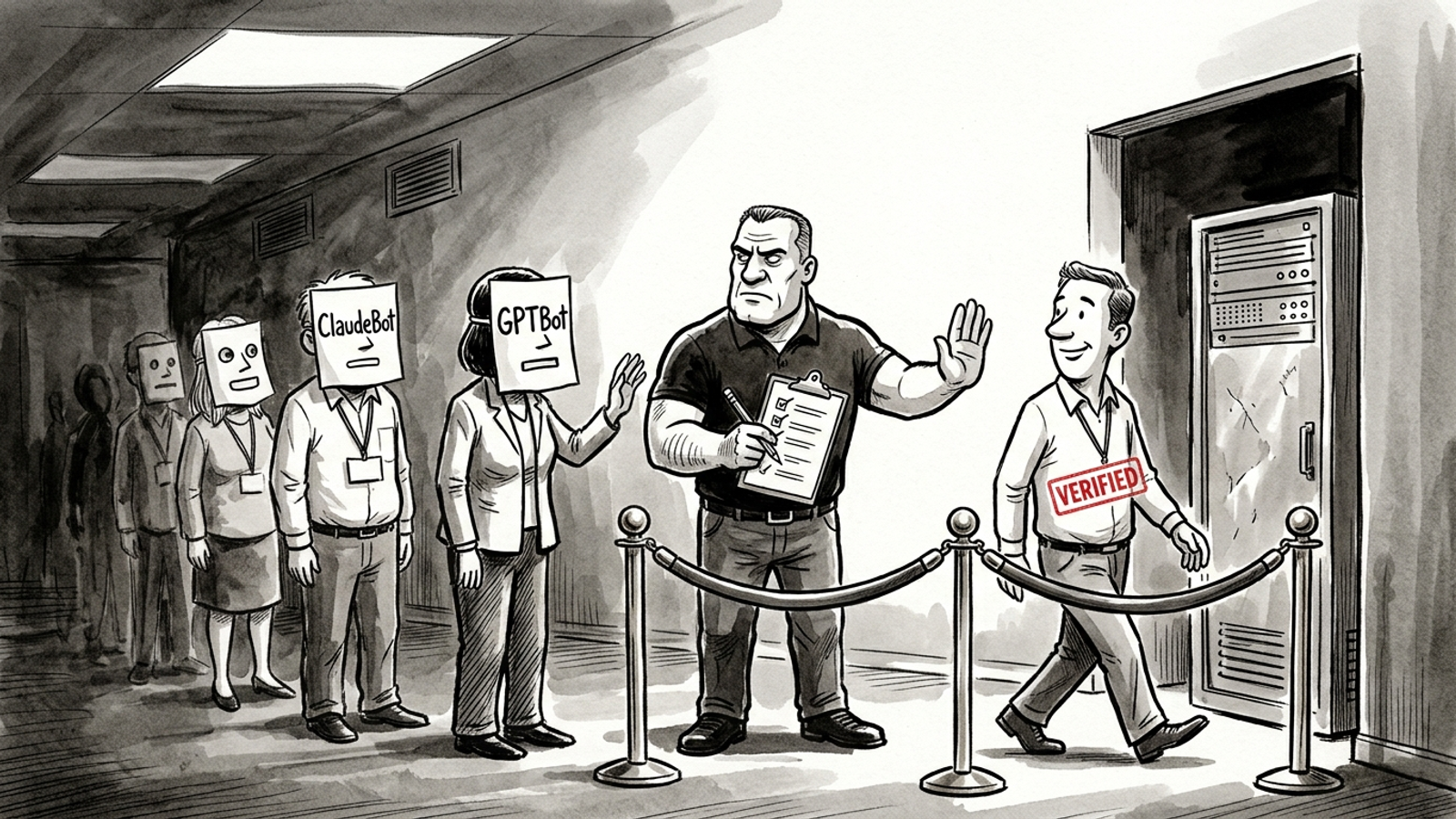
A verified bot hit is a request whose claimed crawler identity has been checked; an unverified hit is merely a request whose user agent says it came from that crawler.
Anyone can put GPTBot in a user-agent string. Verification methods such as reverse DNS or published IP ranges help distinguish a named crawler from something wearing its name. They do not turn a crawler request into AI readership. Even a genuine fetch is a server event, not a person reading an answer.
Counting every bot-named request as readership is like counting every click as a conversion. It flatters the chart and starves the decision. Ask how identity was checked, how many hits passed, and why the vendor thinks those hits measure the thing it claims.
robots.txt and llms.txt
robots.txt gives cooperating crawlers access instructions, while llms.txt offers a proposed list of pages for AI systems to use.
Neither is a magic switch. robots.txt is not a physical gate: crawlers must choose to respect it. And an llms.txt file cannot rescue a product page an answer system cannot access or use. Google has said llms.txt is not necessary for AI search, while one log study found just 84 of 62,100 AI bot hits went to /llms.txt.
I still see proposals that put an llms.txt deliverable above checking whether important pages are blocked. That is backwards. Check access to the pages buyers need before paying for a suggested reading list.
Grounding and passage extraction
Grounding connects an answer to retrieved sources; passage extraction identifies the particular text the answer can use.
Think landing-page relevance, with the limits of the analogy intact. If the page buries the price, the steps, or the comparison inside a wall of marketing copy, a system looking for a concise answer has less useful material to work with. The practitioner’s job is to find the passage that answers a tracked buyer question, not to staple three generic FAQs to every URL and call it grounding optimization.
Ask to see the prompt, the answer, and the exact cited passage. If the vendor cannot connect those three, it has described an edit, not demonstrated its effect.

Entity, knowledge graph, and off-site authority
An entity is a system’s representation of your business as a distinct thing; a knowledge graph connects that thing to identifying information, and off-site authority comes from what other sources say about it.
In paid search, I would call this an identity and relevance problem before I called it a content-production problem. Stable schema IDs, consistent business details, trusted mentions, and knowledge-graph presence are different signals pointing to the same business. If your site and outside profiles disagree about your name, locations, or products, publishing another article may not address the confusion.
I used to treat every missed citation as a request for more content. That was too simple. Ask which identity details conflict and which page or profile you would fix first. Do that before buying more words.
Content gap
A content gap is a buyer question for which another source gets cited and yours does not.
It sounds like lost impression share with a competitor’s name attached. It is not automatically an order for a new post. The answer might already be on a page that is blocked, hard to find, buried under brand story, or spread across near-duplicate URLs. Calling all of those gaps and proposing a page for each is a neat way to sell word count.
A practitioner checks the buyer prompt, the winning source, and the page you already have. Ask which gaps match existing pages and why those pages were not useful in the observed answer. Fix retrieval or clarity before adding another URL.
AI Overview ads
AI Overview ads are paid Google Ads placements shown with Google’s AI-generated search answers.
They are ads, not a paid route into the answer’s cited sources. That distinction should survive every deck. Eligibility and serving can differ from the classic search results you are used to; reported limits on exact match in AI Overviews are a reason to inspect the current setup rather than assume your keyword structure maps neatly onto the placement.
I would treat a new placement the way I treat any unfamiliar slice of search spend: work out what the available reporting can actually separate, then judge the paid outcome against the right baseline. Ask what can be measured separately before accepting a placement-level CPA claim.
Ads in LLMs
Ads in LLMs are sponsored placements presented within or alongside chat experiences, separate from the answer’s earned sources.
For ChatGPT ads described as appearing below an answer and labelled sponsored, the useful PPC instinct is to inspect eligible audiences, surfaces, context, and paid results. The bad instinct is to copy a Google Ads keyword list and assume the same intent controls exist. A chat placement can use contextual hints without behaving like an exact-match search query.
Say you spend $20k/month on search. Do not port your $40 exact bid, see a different pattern of serving, and call the channel broken. First establish what you can target and measure. Ask where your ads can appear, what made them eligible, and what you paid for the resulting clicks.
Paid vs earned AI visibility
Paid AI visibility is an ad appearance you bought; earned AI visibility is an unpaid appearance in an answer or its sources.
They can share a screen without sharing a cause. An advertiser cannot buy inclusion in the ChatGPT answer itself through its ad placement. Treating sponsored impressions and unpaid citations as one visibility total hides the question a search manager needs answered: did spend buy this appearance, or did a source earn it?
I judge paid placements on cost, clicks, and downstream CPA. I judge earned appearances across repeated prompts, separating mentions, citations, and recommendations. Ask for two columns before discussing a trend: paid and earned.
The five definitions to get in writing
I do not ask for a bigger report. I ask for five definitions. Two trackers can produce very different scores for the same brand when their prompts, runs, engines, grounding settings, and formulas differ. Until those are fixed, the headline score is decoration.
- Exact prompt text: Show the buyer questions word for word. A paraphrase is a different test.
- Runs per prompt per engine: State how often each question ran and over what window.
- Model and grounding settings: Name the system tested and whether it could retrieve sources. Do not mix memory-only and grounded answers without saying so.
- Appearance type: Label each result a mention, citation, or recommendation. Reject combined totals that erase the distinction.
- Formula and window: Define the numerator, denominator, dates, and any measure of variation.
Once those stay stable, even a modest weekly check can tell you what moved. That is more useful than a large report that cannot tell you why.
Visibility score
A visibility score is one number meant to summarize how often or prominently a brand appears across a tracker’s AI-answer tests.
In Google Ads terms, imagine selling Quality Score as the business goal. A visibility score can be a private trend inside one stable setup. As a headline, it hides the prompts, runs, engines, and whether paid appearances got folded in with earned ones.
This is the term I would retire. Keep share of voice by prompt group. Keep citation frequency with its sampling window. Keep paid CPA separate. Delete the single number that pretends to be all three. Pick 30 buyer prompts, run them twice, and count mentions, citations, and recommendations by hand before you pay anyone to automate the chart.