

 LinkedIn
If you are the agency owner who still sells SEO by the hour and the deliverable list, your next awkward client email is probably about ChatGPT. You run five, maybe fifteen retainers at $1,500 or $2,000 a month. The scope says two posts, a handful of links, a technical check. You know exactly how many hours each client gets because you priced it that way.
The email will read something like this: My competitor shows up in ChatGPT when buyers ask. We do not. Can you fix that? None of the hours you sold answer that question. Your client will notice the gap in AI results before your retainer has a line item for closing it.
Dear agency owner: your client is asking a different question
42% of agencies already report fielding questions about declining organic traffic, and 66% say clients now ask for AI search visibility. Clients watch conversions, leads, ROI, and revenue far more closely than traffic: those measures account for 89% of what they track, versus 6% for traffic. In a Brainlabs dataset of 54 advertisers, organic sessions fell 10.5% once AI Overviews covered 30%+ of US SERPs, while AI referrals rose 163%. Your client does not care that impressions moved. They care that a buyer asked ChatGPT whom to shortlist and their brand was not named.
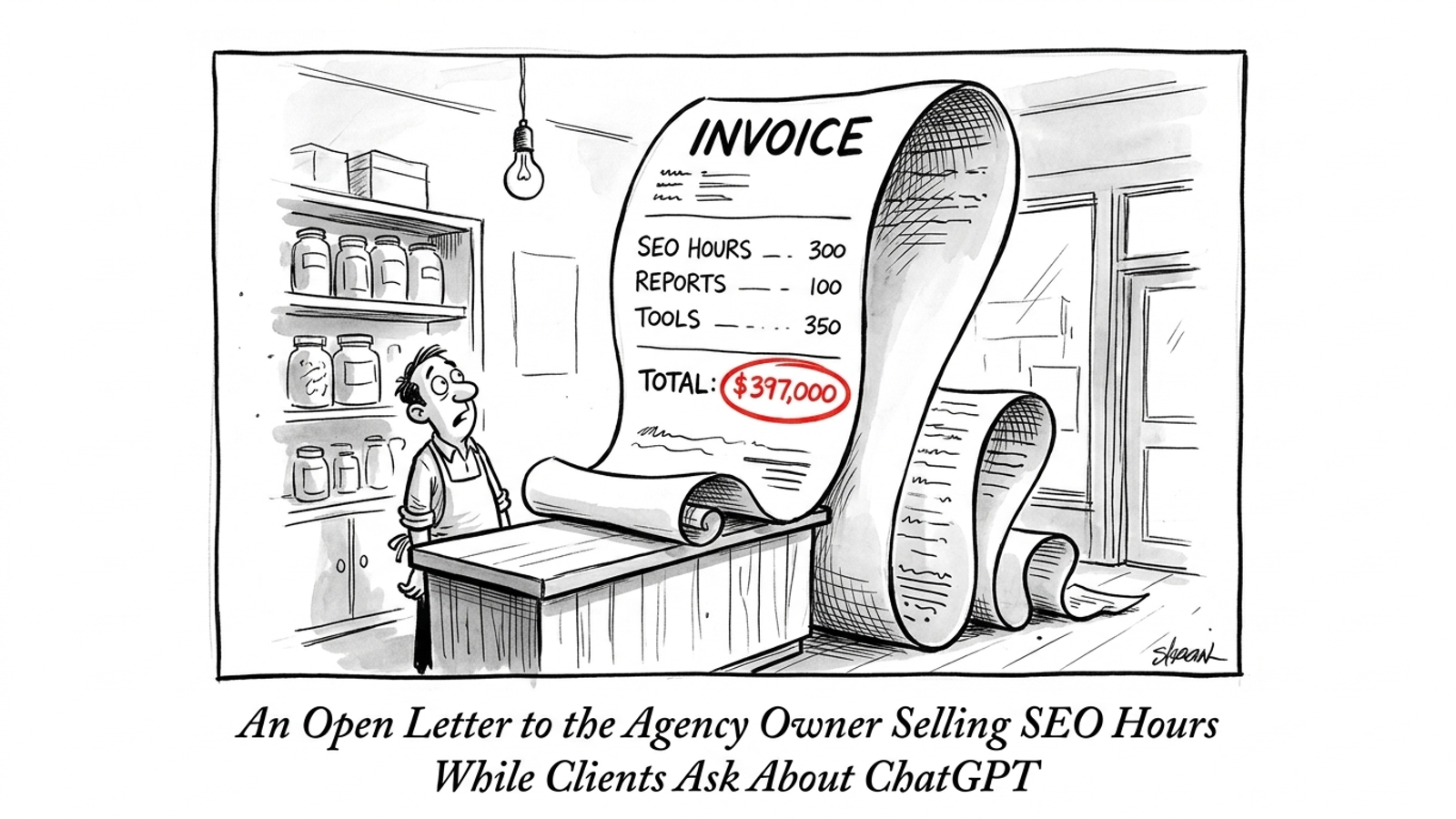
That is the problem your hourly scope does not price. Someone once had to write the post, build the list, run Screaming Frog, and format the report. I know why those hours went on the invoice; I spent enough time doing repetitive account work myself. But when execution gets faster, the hours stop being a convincing product. You still need judgment, access, and work that actually ships. You cannot answer a visibility question by showing the client how long the report took.
At $175 an hour, roughly 11 hours consume a $2,000 retainer before you have accounted for the manager, writer, tools, or another request. The client reads the same invoice and sees two posts and a PDF. Neither of you is talking about whether buyers see the brand in an AI answer. That gap is where the conversation goes next.
I know why the hours are on your invoice
I used to treat time in an account as proof that I was managing it well. Late-night negative-keyword mining could cut wasted clicks, and then the next batch of queries would arrive. The work mattered. Repeating it was not a strategy I could keep selling at the same rate forever.
I was wrong to make the hours the product. The client wanted fewer junk clicks and more qualified calls. My time was a cost of getting there. Your AEO retainer faces the same test: the client will not pay for ten hours of prompt checking just because ten hours went into it. They want to know whether the work gives their brand a better chance of being named.
That does not mean promising a mention you cannot control. It means selling work you can specify, ship, and inspect rather than treating effort as the result.
You have three ways to answer that email
You can hire someone, resell a dashboard that watches the problem, or white-label execution under your name. Each can appear on a proposal. Only one lets you take on ten domains without making every new client question another staffing problem.
Hire an AEO specialist
Hiring gives you control, but one hire is not an entire delivery system. A mid-level in-house SEO costs $60k to $90k in salary, plus 20 to 30% for benefits and taxes and $1,000 to $2,500 a month in tools. That breakdown allows 2 to 3 months to hire and another 1 to 2 to onboard: 4 to 6 months before impact.
Say you pay $75k. You are at about $90k loaded before the tool stack, or around $110k all in at the illustrative tool cost in that breakdown. That person still has a 40-hour week. They can research and brief work across ten clients if little goes wrong; expecting them to publish daily, clear technical debt, build citations, and track eight answer engines as well is a different job. You have bought capacity, but you have also bought a queue.
Resell a monitoring dashboard
The second option looks cheaper because the first deliverable is easy to show. You buy a tracker, put your logo on the PDF, and charge for visibility reporting. Semrush lists its AI Visibility Toolkit at $99 a month per domain, plus $20 a month for white-label reporting. That is $1,428 a year for one domain with reporting, before you do anything about what the report finds. The same comparison lists Otterly at $29 to $489 a month by tier and Peec at $245 to $795 a month. The tier and number of domains change the bill; neither changes what the client asked you to fix.
Your client asked who will get them named in an answer. You handed them a chart showing they are not named. Now your manager has a monthly meeting to explain the gap, with no work to point to between reports. Sell tracking only if you also sell execution. Otherwise, you have made the problem easier to see and no easier to solve.
White-label the work, not just the report
The third option can remove execution hours instead of moving them onto your manager. A delivery partner publishes pages, handles technical work, builds citations, and tracks AI visibility under your name. You remain client-facing. That is different from buying reseller blocks of links or posts, or a software dashboard without a delivery team. Tasks leave you to assemble the service. Charts leave you to explain why nothing shipped.
This is where I would put groas, and not because I like the logo. Its white-label SEO and AI search offering covers content, technical fixes, citations, and weekly Google and AI visibility reporting per client domain. The report carries your brand, and a strategist backs your team without stepping in front of the client. The arrangement matters because the wholesale cost only helps if your people are no longer doing the same delivery work on top of it.
Typical white-label wholesale runs $500 to $3,000 a month per client; at a $2,000 retail price, the cited typical cost is $800 to $1,200. Your margin lives or dies on what that cost buys. If the partner does not publish, fix, and report under your name, you have bought homework.
The cost breakdown your proposal needs
Ten domains at $2,000 each bring in $20,000 a month, or $240,000 a year. At the cited $800-to-$1,200 wholesale range for a $2,000 client, delivery costs $8,000 to $12,000 a month across those ten domains. That leaves $8,000 to $12,000 before account management, access delays, and other overhead. It is a range, not a promise of profit.
The $999-per-domain column below is an illustrative flat-cost scenario, not a quoted groas price. At that cost, ten domains would cost $9,990 a month and leave $10,010 before the same overhead. Keep the alternatives separate: you would not add hourly delivery labor to wholesale delivery costs unless your team were still doing both jobs.
| Cost | Ten-domain hourly or in-house model | Ten-domain white-label scenario | Basis and cost driver |
|---|---|---|---|
| Recurring delivery | About $11,000 for roughly 63 hours at a $175 blended rate | $9,990 at an illustrative $999 per domain | Hourly rate and hours are the example used here; the flat figure is an illustration, not a vendor quote. Scope and extra asks drive labor. |
| Recurring wholesale, if you white-label | Not applicable if your team does the delivery | $8,000 to $12,000 at the cited $800-to-$1,200 cost per $2,000 client | Scope determines the wholesale cost; the $9,990 scenario sits within this range. |
| Recurring tracking, if purchased separately | $990 for ten Semrush AI Visibility Toolkit domains at $99 each, plus white-label reporting fees | Tracking is part of the weekly report in the groas offering described above | Domain count, tool tier, and reporting fees drive any separate bill. |
| Recurring account management | One manager at about $6,500 to $10,000 a month loaded, using the cited $80k-to-$120k annual overhead range | Your own manager still reviews work and handles clients; budget for that time separately | Meetings, approvals, and client requests do not disappear with white-label delivery. Do not count a manager twice in the labor row. |
| One-off hiring delay; recurring salary and tools afterward | 2 to 3 months to hire and 1 to 2 to onboard; $60k-to-$90k salary plus benefits and $1,000-to-$2,500 monthly tools | No AEO hire required for the illustrated delivery model | The delay happens once. Compensation and tools keep recurring. |
The table still misses the friction. A technical fix can sit in your client’s dev backlog because nobody will grant deploy access. A CMS login can fail. A report can need your logo, your tone, and your account manager’s Friday afternoon. None of that becomes free because the delivery fee is flat. It comes out of the spread you thought you had.
This is also where vendors can make a price look tidier than the work. A per-domain tracking fee is not a delivery fee. A wholesale quote is not your total operating cost. A flat execution cost helps you plan only when you know what ships, who gets access, and what still lands on your desk. Ask those questions before you calculate the margin.
Before you sign, ask to see a working week
Ask what your client gets in month one, month three, and month six. Ask how the partner builds for AI citation rather than ranking alone. That is a useful white-label vetting test, because a vendor selling only a dashboard has little shipped work to show you.
Then ask for a sample week for one domain. You should be able to see:
- What was published and what technical work was completed, rather than a list of recommendations waiting for your team.
- How citations were handled and how AI visibility was tracked across engines.
- A report you can send under your own name, with actions your manager can explain.
- What requires your client’s CMS or dev access, so a promised fix does not quietly become your ticket to chase.
If the sample week is mostly charts and future tasks, price the remaining labor yourself. That is the part the wholesale fee has not removed.
If this is not your agency, ignore me
If you run three boutique retainers at $5,000 a month and your clients buy your taste rather than your throughput, you may not need this model. If you want to build an in-house AEO team slowly and can carry the salary and tools while that team learns, hiring may be the decision you intend to make.
I am writing to you if you sit in the middle: too many domains to craft by hand, too little margin to hire whenever demand changes, and clients who are starting to ask whether buyers can find them in answers. You need a way to do the work without pretending the old hours are still the scarce ingredient.
I would test white-label execution on one skeptical client before moving the rest of the book. Keep your retail price, know the per-domain delivery cost, and check what shipped each week. The cheapest mistake is buying one more tracker to look busy. The most expensive is calling that tracker AEO delivery while your manager spends the year explaining a gap nobody is paid to close.
— Alexander